STS vs. DTS Deep Hole Drilling: Which System Delivers Better Chip Evacuation at Volume?
1. Introduction: The Chip That Stops the Line
I have been specifying deep hole drilling systems for hydraulic, oil and gas, and heavy machinery production for over a decade, and I can tell you that the most expensive downtime in a deep hole operation is not a tool break. It is a chip jam.
Here is what that looks like in practice. A hydraulic cylinder manufacturer runs a DTS drilling system on a standard CNC machining center. The hole is 40mm diameter, 800mm deep, in 4140 steel. The chip form is not ideal — the steel produces long, stringy chips that resist breaking. The DTS chip evacuation system, which relies on a vacuum created between two coaxial tubes to pull chips through the inner tube, struggles with the stringy chips. They bridge in the inner tube. The pressure spikes. The operator stops the machine, retracts the drill, and clears the jam. Ten minutes lost. Then it happens again on the next part.
The manufacturer switches the job to an STS machine. The same hole, the same steel, the same chip form. The STS system forces a high volume of coolant through the annular gap between the drill and the hole wall, driving the chips through the large internal passage of the drill tube. The stringy chips do not bridge because the chip passage is larger and the positive pressure is higher. The jam rate drops to near zero. The cycle time is consistent. The line runs.
The difference is not the drill. It is the chip evacuation architecture. STS uses positive pressure and a large chip passage. DTS uses a vacuum and a smaller inner tube. For high-volume production with difficult chip forms, that difference determines whether the line runs or stops.
The global deep hole drilling market continues to expand, driven by demand for hydraulic components, aerospace actuators, and precision mold cooling channels. The selection between STS and DTS — the two dominant BTA-style deep hole drilling systems — is a decision that affects productivity, quality, and machine investment. This guide breaks down the two systems — how they evacuate chips, where each one excels, the machine requirements, the productivity data, and the selection framework that prevents the chip jam that stops the line.
2. How STS and DTS Evacuate Chips Differently
The two systems share the same fundamental goal — remove chips from a deep hole without jamming, without scoring the bore wall, and without stopping the process. They achieve that goal through opposite fluid dynamics.
STS (Single Tube System) is the original BTA system. The drill head is mounted on a single-walled drill tube. A pressure head seals against the workpiece and forces a high volume of coolant through the annular gap between the outside of the drill tube and the wall of the hole being drilled. The coolant travels down that annular gap to the cutting zone, picks up the chips, and drives them back through the hollow interior of the drill tube. The chip evacuation is driven by positive pressure — the coolant is pumped into the annular gap at high pressure, and the only path out is through the drill tube, carrying the chips with it.
The key characteristic of STS is the large chip passage. The interior of the drill tube is a single, unobstructed channel that can handle long, stringy chips and high chip volumes without bridging. The high coolant pressure keeps the chips moving even when the chip form is poor.
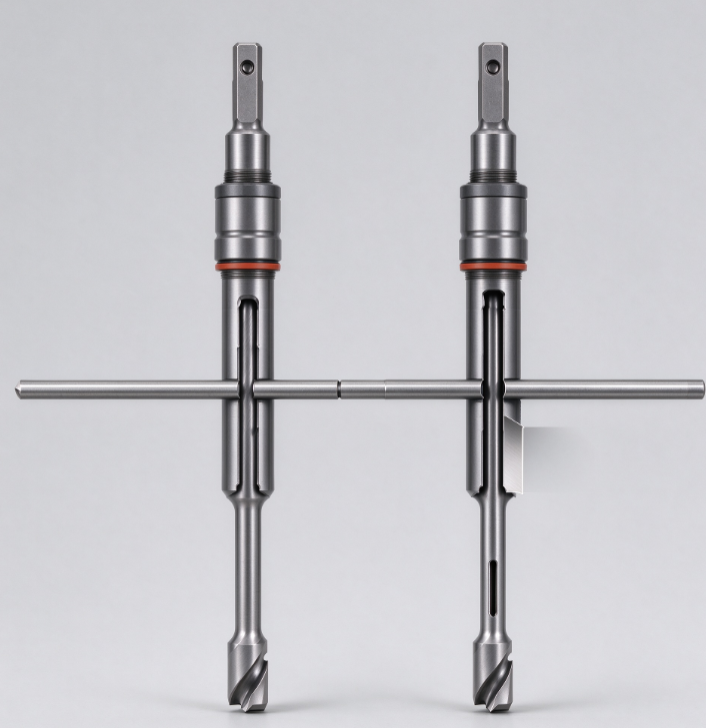
DTS (Double Tube System) — also called ejector drilling — uses a different architecture. The drill head is mounted on a double-walled boring bar with an inner tube and an outer tube. The coolant is supplied through the annular space between the inner and outer tubes. Most of the coolant is forced through holes in the drill head to lubricate and cool the cutting edges. A portion of the coolant is diverted back through the inner tube via a venturi slot. That diverted flow creates a partial vacuum in the inner tube, which pulls the chips and coolant back through the chip exhaust port.
The key characteristic of DTS is the self-contained coolant system. Because the vacuum is created internally, DTS does not require a pressure head sealed against the workpiece. The coolant is supplied through the spindle, which means the system can be installed on a standard lathe or machining center without the dedicated sealing and pressure-head infrastructure that STS requires.
System Feature | STS (Single Tube) | DTS (Double Tube / Ejector) |
Drill tube construction | Single-walled | Double-walled (inner + outer) |
Coolant supply | Through annular gap between tube and hole wall | Between inner and outer tubes |
Chip evacuation drive | Positive pressure | Vacuum created by venturi effect |
Chip passage | Drill tube interior — large, unobstructed | Inner tube — smaller, with venturi restriction |
Pressure head required | Yes — seals against workpiece | No — coolant supplied through spindle |
Machine compatibility | Dedicated deep hole drilling machine | Standard lathe or machining center |
3. Chip Evacuation Efficiency: The Core Comparison
The chip evacuation efficiency difference between STS and DTS is the single most consequential performance gap between the two systems. And it is not marginal.
STS chip evacuation. The positive-pressure system forces a high volume of coolant through the annular gap at pressures typically ranging from 20 to 80 bar depending on the diameter and depth. The coolant volume is the key variable — the system is designed to move a large volume of fluid, which provides the kinetic energy to carry chips out of the hole regardless of their shape or size. The large internal passage of the drill tube provides an unobstructed path for the chips to exit. There is no venturi restriction, no vacuum limitation, and no narrow point where chips can bridge.
The result is that STS handles poor chip forms — long, stringy chips from low-carbon steel or stainless steel — far better than DTS. In materials where good chip breaking is difficult to obtain, the STS system is more reliable because the high pressure and large passage prevent the chips from accumulating.
DTS chip evacuation. The vacuum-based system is inherently less efficient at moving chips than the positive-pressure STS system. The venturi slot that creates the vacuum also creates a restriction in the chip path. The chip passage is smaller than the STS drill tube interior. And the vacuum force is limited by the pressure drop across the venturi.
The practical consequence is a chip evacuation efficiency that is lower than STS. Industry documentation states this directly: “because of less efficient chip evacuation than the STS, the recommended max drilling depth is 1000mm” for DTS. The chip evacuation limitation is the reason for the depth limit — not the drill's mechanical capability, but the system's ability to clear chips from the hole.
There is a nuance worth noting. DTS chip evacuation efficiency can be improved with optimized drill head designs. Research using mesh-free simulation methods has investigated chip evacuation in ejector deep hole drilling and found that optimizing the drill head geometry reduces the minimum volume flow required for stable drilling without chip clogging. The DTS system is not fundamentally incapable — it is simply less forgiving of poor chip forms and requires more careful optimization of the drill head and the coolant parameters.
Chip Evacuation Parameter | STS | DTS |
Drive mechanism | Positive pressure | Vacuum (venturi) |
Chip passage size | Large — full tube interior | Smaller — inner tube with venturi restriction |
Tolerance for poor chip forms | High | Lower |
Recommended max depth | 100× diameter or more | 1000mm standard; 2000mm with DTC-R connector |
Chip bridging risk | Low | Higher with stringy chips |
Coolant pressure range | 20–80 bar | Lower pressure, higher volume |
4. Depth Capability: Where the Gap Widens
The chip evacuation difference translates directly into a depth capability difference. And that difference is not a small margin — it is a factor of two or more in standard configurations.
STS depth capability. The STS system is capable of drilling holes with depth-to-diameter ratios of 100:1 to 200:1 and beyond. The high-pressure coolant and the large chip passage maintain chip flow at extreme depths where the pressure drop through the drill tube would otherwise become prohibitive. The STS system is the standard choice for long-series production where the hole depth exceeds the practical limits of DTS.
DTS depth capability. The standard DTS system has a recommended maximum drilling depth of 1000mm — not 100 times the diameter, but 1000mm absolute. For a 20mm diameter hole, that is an L/D of 50:1. For a 50mm diameter hole, it is only 20:1. The depth limit is a direct consequence of the chip evacuation efficiency — the vacuum can only pull chips through the inner tube for a limited distance before the pressure drop becomes too high.
There is a workaround. The DTC-R tube connector, a specialized component that supplies high-pressure coolant to the DTS system, can extend the achievable drilling depth to 2000mm. But even with that upgrade, the DTS depth capability remains below STS. And the DTC-R connector adds cost and complexity to the system.
The practical implication for high-volume production is straightforward. If the hole depth exceeds 1000mm — or if the L/D ratio exceeds approximately 50:1 — STS is the only reliable option. DTS is limited to shallower holes where its machine compatibility advantage outweighs its chip evacuation limitation.
5. Machine Requirements: Dedicated vs. Standard
The machine requirement is where DTS makes its case. And it is a strong case for certain operations.
STS machine requirements. STS drilling requires a dedicated deep hole drilling machine with a pressure head that seals against the workpiece. The pressure head is the critical component — it must contain the high-pressure coolant while allowing the drill tube to rotate and advance. The workpiece must be sealed against the pressure head, which means the part geometry must accommodate the sealing arrangement. The machine must also have a high-volume, high-pressure coolant system, a rigid spindle, and a support system for the long drill tube.
This is a significant capital investment. A dedicated STS deep hole drilling machine can cost $200,000 to $500,000 or more depending on the size and configuration. The pressure head, the coolant system, and the tooling add further cost. But for high-volume production where the chip evacuation efficiency and depth capability are required, the investment is justified by the productivity.
DTS machine requirements. DTS is designed for standard machines — lathes, machining centers, and general-purpose CNC equipment. The coolant is supplied through the spindle via a special coolant inducer or connector, and the vacuum is created internally by the venturi effect. There is no pressure head sealing against the workpiece. This means the DTS system can be installed on existing equipment without the major infrastructure investment that STS requires.
The trade-off is the chip evacuation limitation and the depth limit. For a shop that already has a CNC lathe or machining center and needs to drill holes in the 500–1000mm depth range with reasonable chip forms, DTS is the practical choice. For a shop that needs to drill holes at 1500mm or deeper, or that routinely encounters difficult chip forms, STS is the only viable option.
Machine Requirement | STS | DTS |
Machine type | Dedicated deep hole drilling machine | Standard lathe or machining center |
Pressure head | Required — seals against workpiece | Not required |
Coolant supply | External, high pressure | Through spindle |
Workpiece sealing | Required | Not required |
Capital investment | High ($200k–$500k+) | Low — uses existing equipment |
Installation complexity | High | Low |
Best for | High-volume, deep holes, difficult chips | Moderate depth, standard machines, good chip forms |
6. Head-to-Head: Complete System Comparison Table
Parameter | STS (Single Tube System) | DTS (Double Tube System) |
Full name | Single Tube System / BTA | Double Tube System / Ejector |
Drill construction | Single-walled tube | Double-walled tube |
Chip evacuation | Internal — through drill tube | Internal — through inner tube |
Coolant supply | Annular gap, external pressure | Between tubes, through spindle |
Chip evacuation drive | Positive pressure | Vacuum (venturi) |
Chip passage size | Large | Smaller |
Tolerance for poor chip forms | High | Lower |
Recommended max depth | 100× diameter+ | 1000mm standard; 2000mm with DTC-R |
Machine requirement | Dedicated deep hole drilling machine | Standard lathe or machining center |
Pressure head | Required | Not required |
Diameter range | Ø38–282 mm typical | Ø18.4–169 mm typical |
Tolerance grade | IT9 | IT9–IT10 |
Feed rates | High — 5–7× faster than gun drilling | High — comparable to STS in favorable conditions |
Best application | High-volume production, deep holes, difficult chip forms | Moderate depth, standard machines, good chip forms |
7. Productivity and Feed Rates in High-Volume Production
Both STS and DTS are high-productivity processes compared to gun drilling. The BTA-style multi-edge cutting head allows feed rates that are 5 to 7 times faster than gun drilling at the same diameter. The difference between STS and DTS in feed rate is less about the cutting capability and more about the stability of the chip evacuation.
STS productivity. The STS system delivers consistent, high feed rates because the chip evacuation is reliable. The positive-pressure coolant flow does not fluctuate, and the large chip passage does not restrict chip movement. The operator can run the process at the optimal feed rate without slowing down to manage chip accumulation. In high-volume production, this consistency is worth more than the peak feed rate — it means the machine runs at the designed cycle time, shift after shift, without the interruptions that erode throughput.
A mold maker using an STS drill system increased feed rates to 8 inches per minute (ipm) for standard cooling holes and 4 ipm for intersecting holes, cutting part cycle time by up to 50 percent. The productivity gain came from the elimination of chip binding problems that had been forcing slower feeds and peck cycles.
DTS productivity. DTS feed rates are comparable to STS in favorable conditions — good chip forms, moderate depths, and well-optimized coolant parameters. The limitation appears when the chip form is poor or the depth approaches the 1000mm limit. At that point, the operator must reduce the feed rate to prevent chip bridging and jamming. The productivity loss is not in the cutting speed — it is in the interruptions required to clear chips and the conservative parameters required to avoid jams.
For high-volume production, the productivity difference between STS and DTS is not the peak feed rate. It is the uptime. STS runs continuously because the chip evacuation is reliable. DTS runs with interruptions when the chip evacuation struggles. Over a shift, over a week, over a year, that difference compounds.
8. Cost Analysis: Machine Investment vs. Per-Part Economics
The cost comparison between STS and DTS is not a simple price comparison. It is a comparison of capital investment versus operating productivity.
STS cost structure. The dedicated STS machine is the largest cost component — $200,000 to $500,000 or more depending on the size and configuration. The pressure head, the high-pressure coolant system, and the tooling add to the initial investment. But the per-part cost is lower because the productivity is higher and the scrap rate is lower. The chip evacuation reliability means fewer rejects from chip-scored bores, and the consistent feed rates mean shorter cycle times.
DTS cost structure. The DTS system uses existing equipment — a standard lathe or machining center. The initial investment is limited to the coolant inducer, the DTS tooling, and the programming. This is a fraction of the STS machine cost. The per-part cost is higher when the chip evacuation struggles — the interruptions, the reduced feed rates, and the occasional chip-scored bore add to the cost per part.
The breakeven calculation depends on the production volume and the hole difficulty. For low-volume production of moderate-depth holes with good chip forms, DTS is the lower-cost option because the capital investment is minimal. For high-volume production of deep holes or holes with difficult chip forms, STS delivers a lower per-part cost despite the higher capital investment. The productivity and quality gains typically recover the machine investment within 12 to 24 months in a high-volume operation.
9. Case Study: A Hydraulic Cylinder Line’s Switch from DTS to STS
The most instructive case study for the STS versus DTS selection comes from a hydraulic cylinder manufacturer that switched a high-volume production line from DTS to STS.
The component. A hydraulic cylinder barrel, 50mm bore diameter, 1200mm deep, in 4140 steel. The L/D ratio was 24:1. The production volume was 400 barrels per month — 4,800 per year. The bore tolerance was IT9, and the surface finish requirement was Ra ≤ 1.6 µm.
The original process. The manufacturer used a DTS system on a CNC lathe with a coolant inducer. The hole depth of 1200mm exceeded the standard DTS recommended limit of 1000mm, but the manufacturer had installed a DTC-R tube connector to extend the depth capability. The chip form in 4140 steel was long and stringy despite the use of chip-breaking inserts.
The problem. The chip evacuation was unreliable at the extended depth. The stringy chips bridged in the inner tube, causing pressure spikes and requiring the operator to stop the machine, retract the drill, and clear the jam. The jam frequency was approximately one jam per 8 to 10 parts. Each jam cost 8 to 12 minutes of downtime. The effective cycle time was 22 minutes per barrel, versus a designed cycle time of 16 minutes. The scrap rate from chip-scored bores was 4.5%.
The evaluation. The manufacturer evaluated an STS system for the same part. The STS machine investment was approximately $280,000. The projected cycle time was 15 minutes per barrel — a 32% reduction. The projected scrap rate was under 1%. The chip evacuation reliability would eliminate the jam-related downtime.
The decision. The manufacturer installed the STS system and moved the 1200mm barrel production to the dedicated machine. The DTS system remained in service for shorter holes (under 800mm) where its machine compatibility was an advantage.
The results. The cycle time dropped from 22 minutes to 15 minutes — a 32% reduction. The jam frequency dropped to near zero. The scrap rate dropped from 4.5% to 0.8% . At 4,800 barrels per year, the cycle time reduction recovered 560 hours of machine time. At a machine rate of $95 per hour, that is $53,200 in recovered capacity. The scrap reduction saved an additional $38,000 per year. The payback period on the $280,000 machine investment was under 3 years — and the manufacturer gained the capacity to take on additional work without adding a second shift.
The lesson. The DTS system was technically capable of drilling the 1200mm hole with the DTC-R connector. But the chip evacuation efficiency at that depth and with that chip form was insufficient for high-volume production. The STS system solved the chip evacuation problem, and the productivity and quality gains justified the machine investment. The decision was not “which system is better” but “which system is reliable enough for the volume and the hole.”
10. The Selection Decision Matrix
Production Scenario | Recommended System | Rationale |
Hole depth < 500mm, good chip forms, standard machine | DTS | Machine compatibility advantage; no pressure head required |
Hole depth 500–1000mm, moderate chip forms | DTS with DTC-R | Standard machine compatibility; extended depth capability |
Hole depth > 1000mm | STS | DTS depth limit exceeded; chip evacuation unreliable |
Difficult chip forms (stainless, low-carbon steel) | STS | Positive pressure and large chip passage handle stringy chips |
High-volume production (>5000 parts/year) | STS | Lower per-part cost; higher uptime; lower scrap |
Low-volume production (<500 parts/year) | DTS | Lower capital investment; existing machine can be used |
Large diameter (>150mm) | STS | Larger chip volume requires larger chip passage |
Small diameter (<20mm) | DTS (limited) | STS tooling not practical below 18mm; DTS range starts at 18.4mm |
Job shop with variable work | DTS | Flexibility to run on existing machines; lower investment risk |
Dedicated high-volume line | STS | Maximum productivity and reliability |
How to read this matrix. The depth is the first gate. Below 1000mm, DTS is viable if the chip form is manageable. Above 1000mm, STS is the only reliable option. The chip form is the second gate. If the material produces stringy chips that resist breaking, STS is the safer choice regardless of depth. The volume is the third gate. At high volumes, the STS productivity and quality gains justify the machine investment. At low volumes, the DTS machine compatibility advantage dominates.
11. Practical Sourcing Framework for B2B Buyers
If you are sourcing a deep hole drilling system for a production operation, here is the framework I recommend.
Step 1: Define the hole first. Diameter, depth, L/D ratio, material, chip form, tolerance, surface finish, and production volume. These eight parameters determine the system selection before any supplier conversation begins.
Step 2: Assess the chip form. The chip form is the single most important variable in the STS versus DTS decision. If the material produces well-broken chips (short, curled, easy to evacuate), DTS can handle the job. If the material produces long, stringy chips (low-carbon steel, stainless steel, some alloys), STS is the safer specification.
Step 3: Check the depth against the DTS limit. The standard DTS limit is 1000mm. The DTC-R connector extends it to 2000mm. If the hole depth exceeds 2000mm, STS is the only option. If the depth is between 1000mm and 2000mm, evaluate the DTC-R option against the STS machine investment.
Step 4: Evaluate the machine availability. Does the shop already have a standard lathe or machining center that can accept a DTS coolant inducer? If yes, DTS may be the lower-cost entry. Does the shop have the floor space and the capital for a dedicated STS machine? If no, DTS may be the only practical option.
Step 5: Calculate the per-part cost, not the machine cost. For high-volume production, the STS per-part cost is lower despite the higher machine investment. The productivity and quality gains recover the investment within 12 to 24 months. For low-volume production, the DTS per-part cost is lower because the capital investment is minimal.
Step 6: Request sample parts from both systems. Before committing to a machine purchase, request sample holes from suppliers running both STS and DTS systems. Measure the cycle time, the surface finish, the straightness, and the scrap rate. The sample test reveals the chip evacuation performance in the actual material and hole geometry.
Sourcing Parameter | STS | DTS |
Max depth (standard) | 100× diameter+ | 1000mm |
Max depth (extended) | — | 2000mm with DTC-R |
Chip form tolerance | High | Moderate |
Machine requirement | Dedicated | Standard lathe or machining center |
Capital investment | High | Low |
Per-part cost (high volume) | Lower | Higher |
Per-part cost (low volume) | Higher | Lower |
Diameter range | Ø38–282 mm | Ø18.4–169 mm |
Tolerance grade | IT9 | IT9–IT10 |
12. Frequently Asked Questions
Q: What is the difference between STS and DTS deep hole drilling?
STS (Single Tube System) uses a single-walled drill tube with a pressure head that forces high-pressure coolant through the annular gap between the tube and the hole wall. The chips are driven out through the drill tube by positive pressure. DTS (Double Tube System) uses a double-walled tube with a venturi that creates a vacuum to pull chips through the inner tube. STS requires a dedicated machine; DTS can be installed on a standard lathe or machining center.
Q: Which system has better chip evacuation?
STS has better chip evacuation efficiency. The positive-pressure system and the large chip passage handle difficult chip forms and greater depths more reliably than the vacuum-based DTS system. Industry documentation states that DTS has “less efficient chip evacuation than STS” and recommends a maximum drilling depth of 1000mm for this reason.
Q: What is the maximum drilling depth for DTS?
The standard DTS maximum depth is 1000mm. With the DTC-R tube connector, the depth can be extended to 2000mm. For depths beyond 2000mm, STS is the only option.
Q: Can DTS be used on a standard CNC machining center?
Yes. DTS is designed for standard machines. The coolant is supplied through the spindle via a coolant inducer, and the vacuum is created internally by the venturi effect. No pressure head or workpiece sealing is required. This is the primary advantage of DTS over STS.
Q: When should I choose STS over DTS?
Choose STS when the hole depth exceeds 1000mm, when the material produces difficult chip forms (stringy chips), when the production volume is high enough to justify the machine investment, or when the diameter is large enough that chip volume requires a large chip passage.
Q: When should I choose DTS over STS?
Choose DTS when the hole depth is under 1000mm, when the chip form is manageable, when the production volume is low to moderate, or when the shop already has a standard lathe or machining center and does not want to invest in a dedicated deep hole drilling machine.
Q: What is the tolerance grade for each system?
STS achieves IT9 tolerance. DTS achieves IT9 to IT10 tolerance. Both are suitable for most hydraulic cylinder and mold cooling applications.
Q: How much faster is STS than gun drilling?
BTA-style drilling — both STS and DTS — is typically 5 to 7 times faster than gun drilling at the same diameter. The multi-edge cutting head and the internal chip evacuation allow higher feed rates without the chip jamming that limits gun drilling.
13. Final Thoughts
Let me leave you with this.
The choice between STS and DTS is not a choice between a good system and a bad one. It is a choice between a system optimised for maximum chip evacuation efficiency and a system optimised for machine compatibility. STS delivers the chip evacuation efficiency that high-volume production demands. DTS delivers the machine compatibility that shops with existing equipment value.
The data is clear. STS handles depths beyond 1000mm, difficult chip forms, and high chip volumes with positive-pressure coolant and a large chip passage. DTS is limited to 1000mm (2000mm with the DTC-R connector) and struggles with stringy chips because the vacuum-based evacuation is less efficient. The case study demonstrates that a hydraulic cylinder manufacturer drilling 1200mm holes at 4,800 pieces per year switched from DTS to STS and cut cycle time by 32%, reduced scrap from 4.5% to 0.8%, and recovered 560 hours of machine time per year.